What Type of Wood Should You Use for a Do It Yourself Kitchen Cabinet
Building your own kitchen cabinets can save money and give you more control over the final look. But before you measure, cut, or drill anything, you have an important decision to make: What type of wood should you use?
The material you choose can affect almost everything. It changes the cost, strength, appearance, weight, and even how difficult the project will be.
For a do it yourself kitchen cabinet, plywood is often one of the most practical materials for the cabinet boxes. Solid woods like maple, oak, and poplar can be excellent for doors and face frames. MDF can also work well for certain painted parts.
There is no single perfect material for every kitchen. Your budget, tools, design, and experience all matter.
This guide will help you understand the best options before you start cutting wood.
Why Your Cabinet Material Matters
Kitchen cabinets work harder than many other pieces of furniture.
You open and close them every day. They hold heavy dishes, cookware, food, and appliances. They are also exposed to heat, steam, grease, and occasional water.
That means your cabinet material needs to offer more than a nice appearance.
Good cabinet material should be:
- Strong enough to hold weight
- Stable in changing indoor conditions
- Easy enough to cut and assemble
- Suitable for screws and hardware
- Resistant to normal kitchen wear
- Compatible with your chosen finish
The best choice also depends on which cabinet part you are building.
You do not necessarily need the same wood for the cabinet box, doors, shelves, and face frame.
Plywood: A Great All-Around Choice
For many DIY cabinet projects, cabinet-grade plywood is a strong place to start.
Plywood is made from thin layers of wood veneer bonded together. The grain direction changes between layers. This construction gives plywood good strength and stability.
Unlike some solid woods, quality plywood is less likely to expand and shrink dramatically with normal humidity changes.
Why Plywood Works Well
Plywood is especially useful for cabinet boxes, side panels, bottoms, and shelves.
A common option is 3/4-inch plywood for major cabinet components. Thinner plywood may be used for cabinet backs or other areas that carry less weight.
Plywood also provides good screw-holding ability when you use proper construction methods.
For beginners, another advantage is its consistency. Large sheets make it easier to build straight cabinet sides without joining several narrow boards together.
What to Watch For
Not all plywood has the same quality.
Cheap construction plywood may contain rough surfaces, gaps, knots, or uneven layers. It can work for many building projects, but it is not always ideal for visible kitchen cabinetry.
Look for cabinet-grade or furniture-grade plywood when your budget allows.
Birch plywood is popular because it offers a clean appearance and is widely used for cabinets. Maple and oak veneer plywood are useful when you want the exposed cabinet surfaces to match solid wood doors or frames.
One downside is the exposed plywood edge. You may need edge banding or a solid wood strip to create a finished appearance.
Maple: Strong, Smooth, and Versatile
Maple is one of the most useful hardwoods for kitchen cabinetry.
It has a fine, fairly smooth grain and a clean appearance. It works especially well in kitchens where you want a simple and polished style.
Maple is hard enough to handle years of everyday use.
For a do it yourself kitchen cabinet, maple can be a good choice for:
- Cabinet doors
- Drawer fronts
- Face frames
- Trim
- Visible wood details
Maple plywood can also be used for cabinet boxes.
Is Maple Beginner-Friendly?
Maple is workable, but it is harder than softer woods. Cutting and shaping it may require more effort.
Sharp blades and drill bits are important. Pre-drilling screw holes can also help reduce problems.
Finishing maple takes some care. Certain stains can look uneven if the wood is not prepared correctly. A clear finish can be a simpler option when you like maple’s natural appearance.
Oak: Classic Strength With Visible Grain
Oak has been used in kitchens for decades, and there is a good reason for that.
It is strong, durable, and easy to recognize because of its noticeable grain pattern.
Red oak and white oak are both used for cabinets. However, they have different tones and grain characteristics.
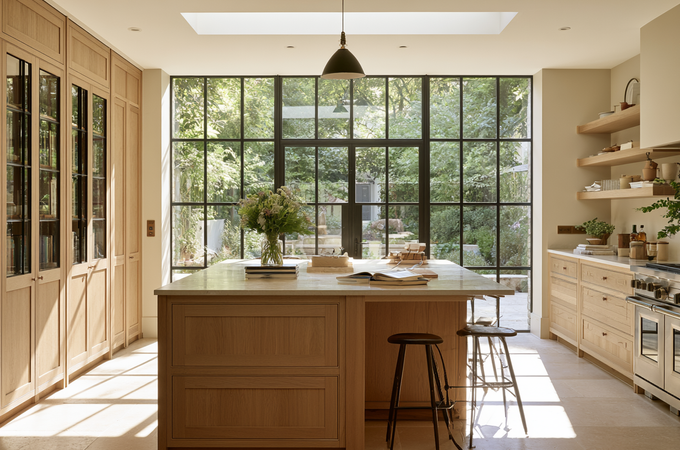
White oak has become especially popular in modern kitchens. Its natural appearance can work beautifully with warm, minimalist, Scandinavian, and modern designs.
Oak is also useful if you want your DIY cabinets to show real wood character instead of having a perfectly smooth surface.
When Should You Choose Oak?
Consider oak when you want:
- Strong cabinet doors and frames
- A visible natural grain
- A stained or clear wood finish
- A traditional or modern natural-wood look
- Long-lasting cabinet components
Oak is harder than many beginner materials, so good tools make a difference.
The strong grain can also remain visible under paint. If your goal is a completely smooth painted door, MDF or another fine-grained material may make more sense.
Poplar: A Smart Choice for Painted Cabinets
Poplar deserves more attention from DIY cabinet builders.
It is generally easier to cut, drill, sand, and shape than many harder woods. That can make it useful for someone building cabinets at home with standard woodworking tools.
Poplar is often used for painted face frames, door frames, and trim.
Its natural color can vary. You may see cream, yellow, green, or brown areas in the same board. For this reason, many builders prefer painting poplar instead of using a clear finish.
If your finished cabinets will be painted, the natural color variation usually does not matter.
Poplar can therefore offer a useful balance between solid wood construction and easier woodworking.
MDF: Not Wood, but Still Worth Considering
Medium-density fiberboard, better known as MDF, is an engineered wood product.
It is made from wood fibers combined with resin and pressed into dense sheets.
MDF does not have the natural grain or character of solid wood. However, that can actually be an advantage for painted cabinets.
Its surface is smooth and consistent.
This makes MDF especially useful for painted cabinet doors and decorative panels.
Advantages of MDF
MDF offers several DIY-friendly benefits.
It has no knots, and you do not have to worry about grain direction in the same way you would with solid wood.
It can also be shaped with a router to create different door profiles.
Once properly prepared and painted, MDF can create a very smooth finish.
The Big Weakness: Moisture
MDF and water are not good friends.
If unfinished or poorly sealed MDF absorbs enough moisture, it can swell and become damaged.
Kitchen spills, sink leaks, and wet floors make moisture protection especially important.
MDF is also heavy and creates very fine dust when cut. Good dust collection and suitable respiratory protection are important when working with it.
For these reasons, MDF is often better for selected cabinet parts rather than every part of the cabinet.
Pine: Affordable but Softer
Pine is widely available and relatively easy to work with.
It is a softwood, which means cutting and drilling are usually easier than with hard maple or oak.
That sounds perfect for a beginner, but softness comes with a trade-off.
Pine can dent and scratch more easily.
It also has knots and natural grain variation. Some people love this character. Others may find it difficult to create a clean, modern cabinet appearance with pine.
Pine can make sense for farmhouse, rustic, cottage, or budget-focused projects. Just understand that it may show signs of everyday use faster than harder woods.
Solid Wood or Plywood: Which Is Better?
You might assume solid wood must be better because it sounds more premium.
Cabinet construction is more complicated than that.
Solid wood is excellent for doors, frames, trim, and decorative components. However, it naturally expands and contracts as moisture conditions change.
Large solid wood panels can move over time.
Plywood is more dimensionally stable because of its layered construction. This makes it particularly useful for large cabinet box panels.
A smart do it yourself kitchen cabinet can actually combine materials.
For example, you could use:
- 3/4-inch cabinet-grade plywood for cabinet boxes
- Solid maple or poplar for face frames
- Solid wood and plywood for traditional door construction
- MDF for certain painted doors or panels
- Thin plywood for cabinet backs
You get the advantages of each material without forcing one wood type to do everything.
What About Particleboard?
Particleboard is common in affordable furniture and some factory-made cabinets.
Its biggest attraction is price.
However, it would not usually be my first choice for a DIY cabinet project where durability and easy repair matter.
Particleboard can be more vulnerable to moisture damage. Screw holding can also become a concern, especially if hardware is removed and reinstalled several times.
High-quality engineered cabinet products can perform well when designed correctly. Still, a DIY builder often gets more flexibility from good plywood.
If your budget allows, spending more on the cabinet box material can pay off over the life of the kitchen.
Best Wood for Painted DIY Cabinets
If you plan to paint your cabinets, you do not need expensive wood with beautiful grain.
After all, the paint will hide it.
Poplar is a practical solid wood choice for painted face frames and door components.
MDF can create very smooth painted door panels.
Plywood can handle the main cabinet structure.
This combination can give you strong cabinets without paying for premium decorative hardwood everywhere.
Careful sanding and priming are just as important as the wood itself. Even expensive material can look poor under paint if the surface preparation is rushed.
Best Wood for Natural-Finish Cabinets
A clear or stained finish changes the decision.
Now the grain, color, and texture of the wood become part of the design.
Maple gives you a cleaner and more subtle look. Oak offers stronger grain and more visual texture. White oak is particularly useful when you want a warm natural look.
Walnut is another beautiful option, but it can be significantly more expensive.
Before buying large quantities, get sample pieces of your preferred wood. Apply your planned stain or clear coat.
Wood can look very different after finishing.
A small test now can prevent a costly mistake later.
Think About Your Tools Before Buying Wood
Do not choose your material based only on appearance.
Think about how you will actually build the cabinets.
Hardwoods may be difficult to work with if you have limited tools. Large plywood sheets can also be awkward to handle alone.
A basic cabinet project may require tools such as a circular saw or table saw, drill, measuring tools, clamps, sanding equipment, and a reliable way to make straight cuts.
A router can help with doors, edges, and joinery, but it is not necessary for every cabinet design.
The simpler your cabinet design, the easier it will be to complete accurately.
Don’t Forget the Hardware
Great wood cannot save poorly installed hardware.
Hinges, drawer slides, handles, shelf supports, and fasteners all affect how your cabinets perform.
Choose screws that are suitable for your cabinet material. MDF, plywood, and solid hardwood do not always respond to fasteners in the same way.
Heavy drawers also need slides that can support their expected load.
Plan your hardware before final assembly. It is much easier to drill accurate holes while cabinet parts are accessible.
Which Material Should a Beginner Choose?
For a first DIY cabinet project, a mixed-material approach is often practical.
Use quality plywood for the main cabinet boxes. Then choose poplar, maple, or oak for visible solid wood parts depending on your finish.
For painted cabinet doors, MDF can be considered where moisture exposure is limited and all surfaces and edges can be properly sealed.
This approach keeps construction manageable while still giving the finished kitchen a professional appearance.
Most importantly, buy straight, flat, dry material. Premium wood that is badly warped can cause more trouble than a less expensive material in good condition.
Common Wood Selection Mistakes to Avoid
The wrong decisions at the beginning can create hours of extra work.
Avoid buying wood based only on price. Cheap material may require more sanding, filling, straightening, or replacement.
Do not ignore moisture. Areas around sinks and dishwashers need extra attention.
Also, avoid mixing random woods if you plan to stain everything. Different species can absorb stain differently, creating mismatched colors.
Finally, check the actual thickness of sheet goods before planning every cut and joint. The stated size and exact measured thickness are not always identical.
Final Thoughts
Choosing wood is one of the most important parts of building a do it yourself kitchen cabinet.
For many projects, cabinet-grade plywood is an excellent choice for the main boxes because it is strong and stable. Maple and oak are great choices when natural wood will remain visible. Poplar works especially well for painted frames and trim, while MDF can create smooth painted doors and panels.
You do not need to build the entire kitchen from one material.
In fact, combining plywood, solid wood, and engineered materials can often produce a better cabinet.
Start with your budget, cabinet style, finish, and available tools. Then choose each material based on the job it needs to perform.
Good cabinets begin long before assembly. They begin with choosing the right material.